| Cause | What happens | Clue |
|---|---|---|
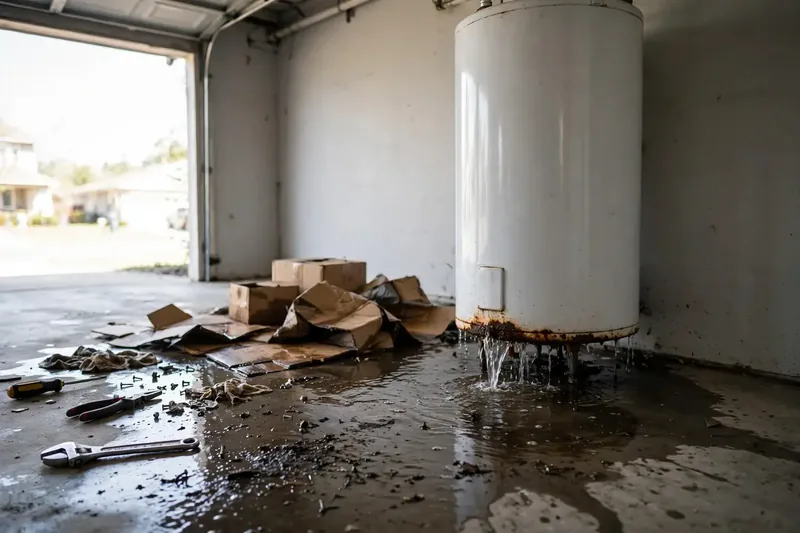
| Tank corrosion | After years of use, the steel tank rusts from inside and starts to weep, then splits | Rusty water, rust at the tank base, age over 10 years |
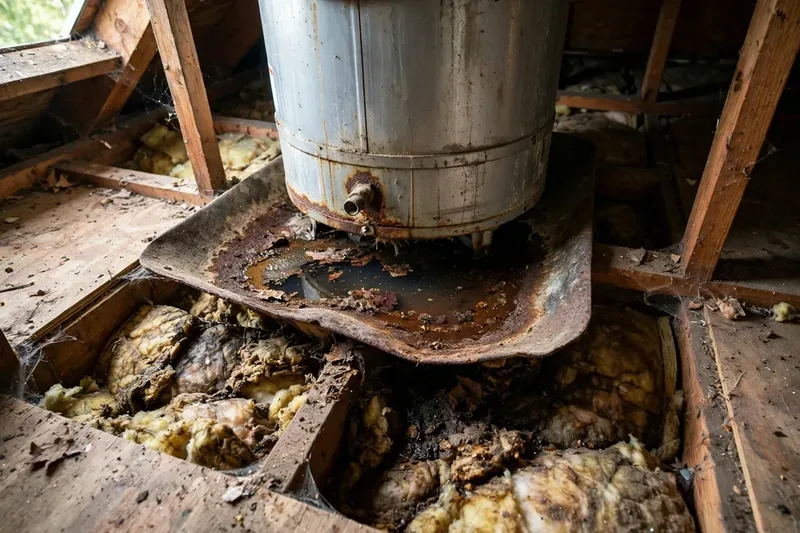
| Overflowing drain pan | The pan holds a few gallons; a tank leak quickly overwhelms it, or the pan drain line is clogged or missing | Water around the pan, wet insulation next to it |
| Rusted-through pan | Older metal pans corrode and leak even a small drip straight through | Rust stain on the pan bottom |
| Relief valve (T&P) discharge | The temperature and pressure relief valve opens and its drain line is blocked, loose or never ran outside | Water at the valve, a drip line outside that runs often |
| Supply line or fitting failure | A flexible connector or a fitting at the top of the tank cracks | Spray or drip from the top, not the bottom |
| Freeze damage | Attic pipes to and from the heater freeze in a hard cold snap | Leak appears after a freeze, as things thaw |
Attic Water Heater Leak Cleanup in Plano, TX
A water heater in the attic holds 40 to 50 gallons, and the supply line keeps refilling it until someone closes the valve. When the tank or a fitting fails, water floods the drain pan, soaks the insulation and comes through the ceiling below. Close the cold-water valve on top of the tank now. Then call us to remove the water, dry the attic and ceiling, and stop the damage spreading.
- Local technicians
- Written scope
- Moisture monitoring
- 24/7 emergency response
Water Heater Leaking in the Attic? Do This Now
- Close the cold-water valve on the pipe going into the top of the tank. Turn it clockwise until it stops. If you can't reach it safely, shut off the main valve for the house instead.
- Turn off the heat source. Gas: set the control knob to "off" or "pilot." Electric: switch off the water heater's breaker. An empty electric tank with the power on can burn out its elements.
- Stay off the attic decking if it's soaked, and never walk between joists. Wet drywall below won't hold your weight.
- Catch water below with buckets and towels. Switch off breakers for any ceiling light that's dripping.
- Keep people out from under a sagging ceiling. A water heater can release far more water than an AC drip, so ceilings can fail faster.
- Take photos of the tank, pan and every wet ceiling and floor.
- Call a plumber to repair or replace the heater, and call us to dry the house. Don't drain the tank yourself unless you know how; hot water and sediment come out fast.
Why Attic Water Heaters Leak
Signs Your Attic Water Heater Is Leaking
- A stain on the ceiling directly below where the water heater sits
- Water dripping from a pipe outside under the eave (the relief or pan drain line)
- Rusty or discolored hot water
- Popping or rumbling from the attic when the heater runs, a sign of heavy sediment
- Hot water running out sooner than it used to
- A musty smell upstairs, or warm, damp air near the attic access
Why This Is a Plano Problem
Plenty of two-story homes in Central, North and West Plano put the water heater in the attic, often beside the air handler. Many of those homes were built from the 1980s through the 2000s, so tanks on their second or third replacement are common, and some original metal pans are still in place.
North Texas water is hard, which means sediment and scale build up inside tanks and shorten their lives. Attics swing from extreme summer heat to near-freezing in winter, stressing fittings and connectors. When a tank fails up there, gravity does the rest: water spreads through blown-in insulation and reaches the ceiling over a wide area before anyone downstairs notices.
Where the Water Goes From an Attic Tank
A failing tank doesn't drip politely. Water spills over the pan, runs across the attic platform, and soaks the loose insulation in every direction. From there it reaches the back of the ceiling drywall, follows the joists to light fixtures and vents, and can run down the top of interior walls into the rooms below. In a two-story home, that can mean wet ceilings on the second floor and, if enough water escapes, wet walls and flooring on the first.
Because the visible stain is only where water finally broke through, the wet area above is almost always larger. That's why we map the moisture before deciding what to remove.
How We Clean Up After an Attic Water Heater Leak
If the ceiling took most of the damage, see ceiling water damage for more on repairs.
- Make sure it's off. We confirm the supply valve is closed and the heater is shut down, so nothing restarts while we work.
- Map the wet area in the attic, ceilings, walls and floors with thermal imaging and moisture meters, and record every reading.
- Clear the attic. Soaked insulation around the tank comes out, and we dry the platform, joists and the back of the drywall.
- Open only what's needed. Ceiling drywall that's sagging or crumbling is cut out in sections. Firm, damp drywall is usually dried in place.
- Check the walls and floors below. If water ran down walls, we check the bottom plates and the flooring underneath.
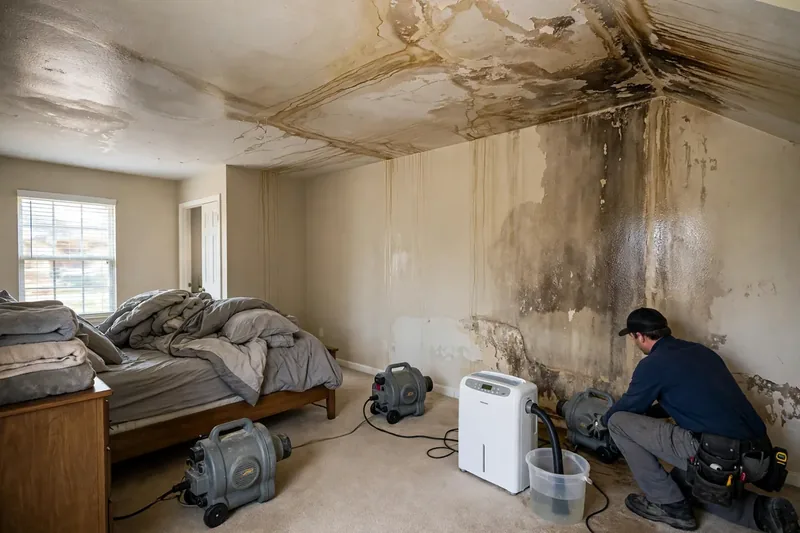
- Dry the structure. Dehumidifiers and air movers are placed in the attic and the rooms below. See structural drying for how we size and monitor them.
- Clean and document. Rust and sediment can stain and dirty surfaces, so affected areas are cleaned. Daily readings and photos go into a drying log you keep.
What Can Be Saved
| Material | Usually saved when... | Usually replaced when... |
|---|---|---|
| Ceiling drywall | Damp but firm and flat, caught quickly | Sagging, crumbling or soaked through |
| Blown-in insulation | Lightly damp at the edges | Matted, soaked or discolored by rust |
| Attic decking (plywood/OSB) | Surface wet only | Swollen, soft or delaminating |
| Framing and joists | Almost always, with airflow and dehumidification | Only with long-term decay |
| Walls below | Bottom-only dampness | Wet drywall with long exposure or insulation inside |
| Flooring below | Tile and sealed surfaces | Carpet pad after heavy water; cupped hardwood that won't flatten |
Attic Water Heater or AC? How to Tell
Many Plano attics hold both, side by side. A water heater leak usually doesn't stop when you turn the AC off, the water may feel warm, and it often leaves rust stains. An AC overflow mostly happens while the AC is running in summer, and the water is cool. If your leak matches the AC instead, see AC leaking through the ceiling. For a heater in the garage or a laundry closet, see water heater leak cleanup.
Insurance and Attic Water Heater Leaks
Many Texas homeowners policies treat a sudden tank rupture differently from a slow leak that went on for weeks. The water heater itself is usually treated as a worn-out appliance and isn't covered the way the resulting water damage may be. Details depend on your policy, so check with your insurance company. We document the tank, the pan, every wet area and every reading from start to finish. Our guide to sudden vs. gradual water damage in Texas explains the difference.
Preventing the Next Attic Leak
- Know your tank's age. The date is on the label or in the serial number. Many tanks start leaking somewhere past 10 years; plan replacement before then.
- Flush the tank yearly to clear sediment, especially with North Texas hard water.
- Have the anode rod checked every few years. It's what keeps the tank from rusting.
- Make sure the pan has a drain line that runs outside and isn't blocked.
- Add a leak sensor or automatic shut-off valve in the pan. Some close the supply on their own when they sense water.
- Consider moving it. When it's time to replace, ask your plumber about a tankless unit or a location outside the attic.
Attic Water Heater Leaks Across Plano
We also cover North Plano (75025), Murphy, Frisco and McKinney. For everything else water-related, see water damage restoration in Plano.
- Central Plano: 1980s and 1990s two-story homes where attic tanks are now on their second or third replacement.
- West Plano and Willow Bend: larger homes, sometimes with two water heaters in the attic.
- Allen: newer two-story homes with attic tanks above bedrooms and game rooms.
Attic Water Heater Leak FAQs
Close the cold-water valve on the pipe going into the top of the tank, then turn the gas to "off" or switch off the breaker. If you can't reach the valve safely, shut off the main water to the house.
The tank holds 40 to 50 gallons, and the supply keeps refilling it until the valve is closed. A full failure can release far more water than the tank holds.
The pan handles small drips and holds only a few gallons. A split tank overwhelms it quickly, and a rusted or undrained pan won't catch much at all.
Only the sections that are sagging, crumbling or soaked through. Firm drywall that's only damp can usually be dried in place.
Lightly damp insulation at the edges can dry. Soaked, matted or rust-stained insulation should come out, because it holds water against the ceiling and won't insulate properly again.
Often 3 to 5 days, depending on how much water escaped and how many rooms below it reached.
No. A plumber repairs or replaces the heater. We handle the water damage: removing what can't be saved and drying the attic, ceilings, walls and floors.
It's worth asking your plumber when the tank is due for replacement. A tankless unit or a garage location removes the risk of a ceiling flood.
Water Heater Leaking Through Your Ceiling?
Close the cold-water valve, turn off the heater, and call (972) 945-2118. We'll talk you through the next steps while we get moving.